

For three years, owning “the AI trade” meant owning the megacap platforms. One theme, one basket, one decision. That shorthand has stopped working, and the index level is the last place you would notice.
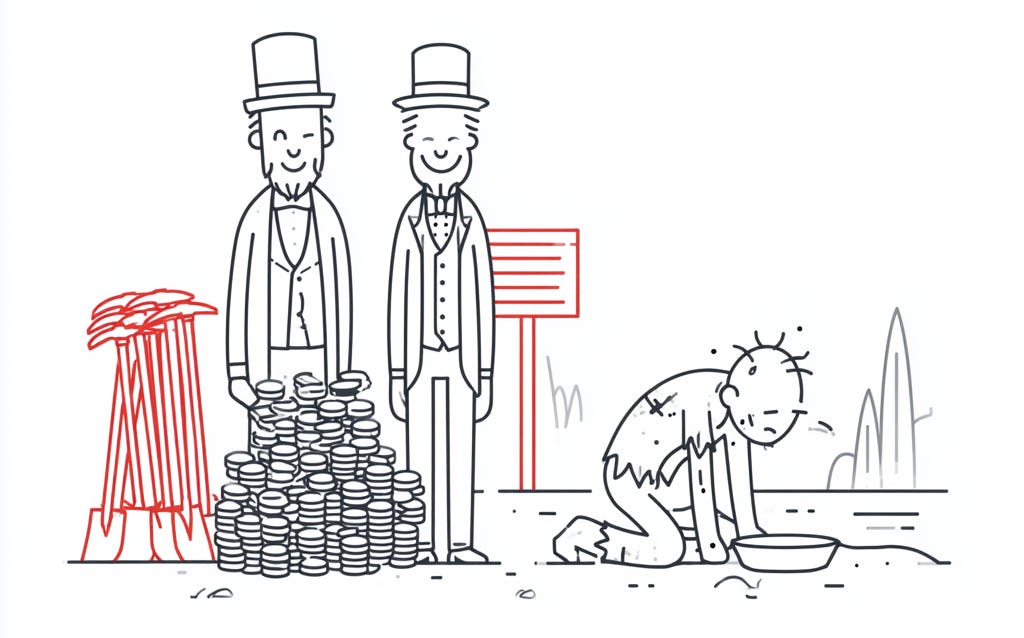
During the California gold rush, the people who reliably got rich were not the prospectors. They were the merchants selling picks, shovels, pans, and tents. Whether any individual miner struck gold, the suppliers got paid. The AI cycle now rhymes with that pattern. The hyperscalers, GOOGL, AMZN, META, and MSFT, are the prospectors staking enormous claims on future demand. The chip, memory, and networking suppliers are the merchants, booking revenue from every participant in the race.
Measured across horizons, the two baskets have diverged sharply. The enabler group has led over the quarter and the year while the hyperscaler group gave back ground, even as the broad index held near highs. Nomura’s Charlie McElligott has described the market’s recent pressure as a rotation out of hyperscaler capex exposure and into the bottleneck enablers, with the biggest spenders acting as a drag on the index rather than its engine.
The skepticism toward the spenders is about cash, not mood. Goldman Sachs Research estimates the largest cloud operators will spend around $770 billion on capital expenditure in 2026, roughly their entire operating cash flow. Funding that pace has meant more debt and equity issuance, fewer buybacks, and materially higher aggregate net debt since early 2025. Meanwhile the suppliers convert the same build-out into revenue and margin today. The same research notes AI-infrastructure beneficiaries should account for about half of S&P 500 earnings growth this year, with semiconductors the primary direct beneficiary. Leadership is not just narrow. It is narrowing toward one link in the chain.
Breadth is where this becomes visible before it becomes news. Goldman has called current breadth among the narrowest since the dot-com era. RBC’s work on concentration puts the ten largest companies at roughly 40% of the index, a record. Schwab notes the average index member has suffered a maximum drawdown near 21% this year while the index itself stayed calm. A market carried by a few names is more fragile than the same index level carried broadly, because less sits underneath to absorb a stumble.
What does a trader do with this? Treat it as a dispersion environment. The useful question is no longer whether to own AI but which link of the chain carries the relative strength. Passive index exposure increasingly behaves like a concentrated thematic bet, so balance has to be judged by industry participation, not by counting holdings. And persistent dispersion between a leading group and a lagging group is the natural habitat of a long/short structure: express the bias through the leaders, stay aware of the laggards, and let low correlation between the two sides do the diversifying.
The behavioral trap is buying the slogan. Anchoring to the familiar platform names while relative strength migrates to their suppliers, extrapolating the steepest part of a momentum move, ignoring participation because the index looks fine. The antidote is not a forecast. It is a repeatable check of breadth, leadership, and durability before adding risk.
The AI trade did not end. It split. Reading that split early, at the industry level, is the difference between positioning on structure and reacting to headlines.
Full research and methodology at imgeld.com