

Every trader eventually faces the same night: a position you like, an earnings report tomorrow, and a decision that no chart pattern can make for you. The stock will reprice before the next session opens, and nothing you drew on the chart will matter for that gap.
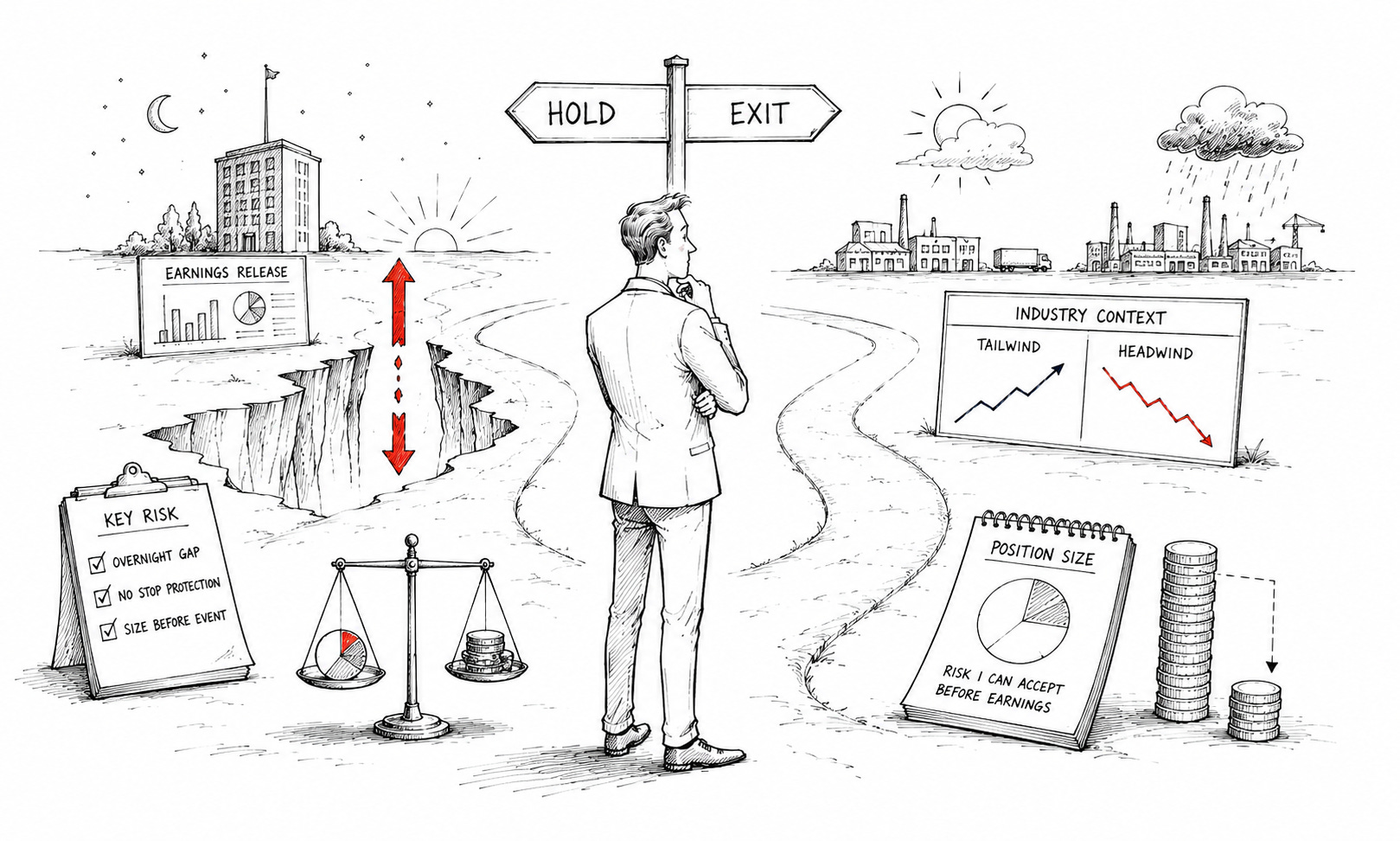
Is it safe to hold? No. Not in the way most people mean the word. But unsafe does not mean untouchable. Earnings risk is a known, measurable exposure, and the professional response to a known exposure is sizing, not avoidance and not bravado.
Start with the mechanics. Most companies report before the open or after the close. The first price you can trade often reflects a complete overnight repricing, which means the stop-loss you set during regular hours protected you from nothing. The SEC has flagged that extended-hours sessions add their own liquidity and pricing problems on top of the gap itself. Whatever protection you want has to be built into the position size before the announcement. Afterward is too late.
Now the part traders get wrong about surprises. An earnings surprise is just the gap between reported results and consensus estimates. Two documented patterns should shape how you think about it.
First, the reaction is asymmetric. Nasdaq’s own reference material notes that negative surprises tend to punish a stock harder than positive surprises reward it. A beat is not the mirror image of a miss.
Second, the move does not end at the announcement. Research on post-earnings announcement drift, going back to foundational work by Bernard and Thomas cited by CFA Institute, shows stocks continuing in the direction of a genuine surprise for up to 60 days. That is a documented anomaly about market-wide tendencies. It tells you surprises matter beyond day one. It tells you nothing about which side your stock lands on.
So where does an edge in the decision actually come from? Context. A company reporting into a strong industry has room to absorb a modest miss. The same miss, delivered into an industry already under selling pressure, compounds it. The hold-or-exit question at the single-ticker level ignores the backdrop that will shape the reaction.
That backdrop turns the decision from a guess into arithmetic. Instead of asking whether to hold, ask: given where this industry stands and given that a gap in either direction is possible, what position size lets me accept the outcome? Sometimes the answer is the full position. Sometimes it is a trim rather than an exit, keeping exposure to the thesis while shrinking the dollar impact of the overnight move.
Neither holding through earnings nor selling before every report is a rule worth having. Both are risk decisions, and risk decisions belong to position sizing and context, made before the event. The goal was never to predict the surprise. It is to make sure the surprise, whichever way it breaks, was already paid for.
Full research and methodology at imgeld.com