

Concentration risk is supposed to be the obvious kind of risk: one stock, too big, everyone can see it. The version that actually bites hides inside the thing investors treat as the definition of diversification. Owning the S&P 500 today is, quietly, an outsized bet on a handful of mega-cap names.
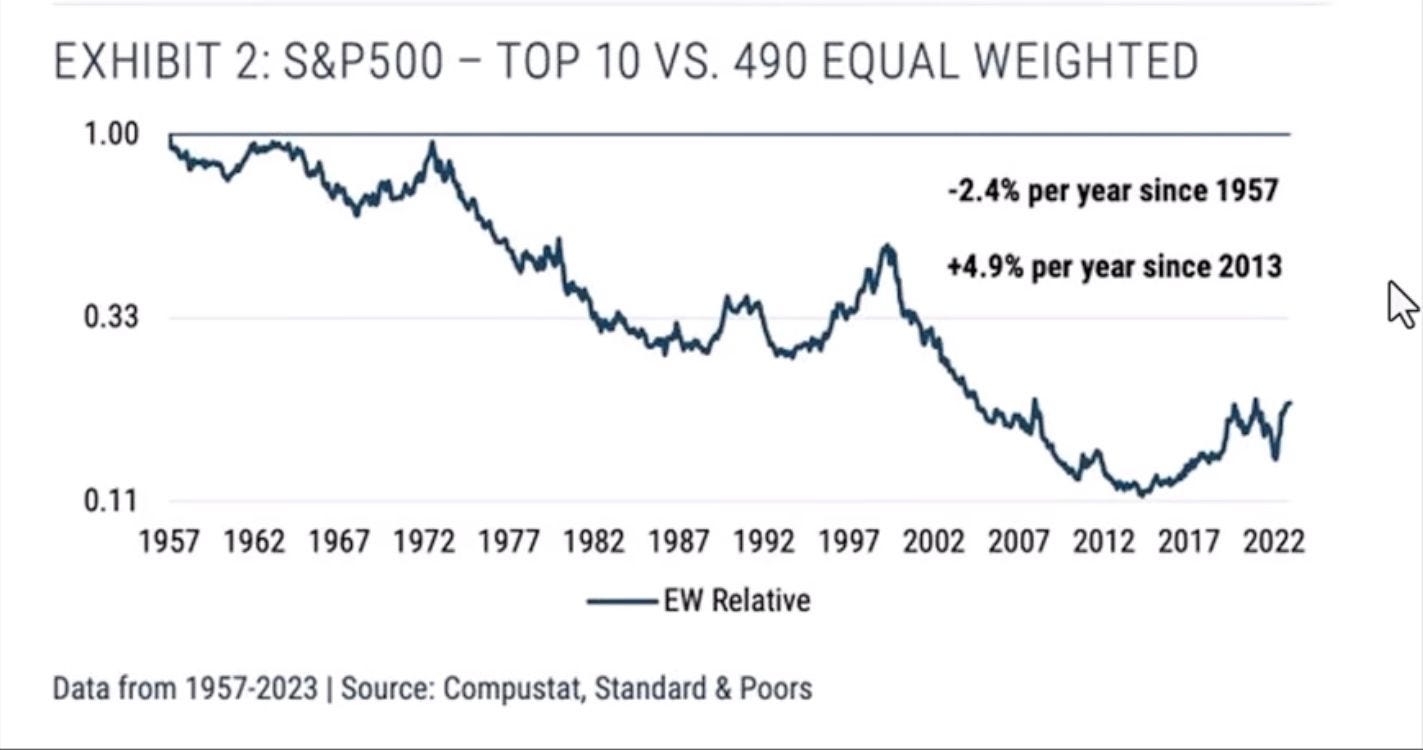
The long-run evidence deserves a slow read. Research from GMO, the firm Jeremy Grantham co-founded, shows that since 1957 the ten largest stocks in the index have underperformed an equal-weighted basket of the remaining 490 by roughly 2.4% per year. Across nearly seven decades of bull markets, recessions, and everything between, holding the biggest names was the losing side of the trade on average.
The mechanism is not mysterious. By the time a company reaches the top ten, it has already delivered years of exceptional growth. Expectations are elevated, the good news is priced, and the base is enormous. Repeating the climb from that altitude is far harder than it was on the way up. Academics file it under mean reversion: what rises to an extreme tends to normalize. A trader treating today’s leaders as a permanent core holding is implicitly betting they will keep defying a pattern that held for seventy years.
Then comes the honest complication. Since 2013 the script has inverted. The ten largest stocks have beaten the other 490 by roughly 4.9% per year, a run without precedent anywhere in the series. Two explanations fit the data and nobody can prove which one holds. Either a small group of technology platforms represents a genuinely new kind of business that compounds at unprecedented scale, or the seventy-year pattern eventually reasserts itself and concentrated portfolios absorb a painful adjustment. A disciplined process does not need to pick between those futures. It needs to be positioned so that either one is survivable.
That reframing turns concentration from an accident into a choice. A cap-weighted index feels diversified while it silently loads the book into whatever is already largest and most expensive. The equal-weighted version of the same 500 companies works as a mirror: when it lags the cap-weighted index badly, leadership is narrow and concentration risk is elevated. Tracking that gap costs nothing and reads the market’s structure directly.
For construction, the practical rules follow. Assess leadership at the industry level rather than defaulting to the mega-cap layer. Select names on relative strength within genuinely strong industries, not on sheer size. Cap what any single name or single theme can do to the outcome, regardless of how invincible the leaders look this quarter.
The behavioral part is the hardest. When the giants lead for years, staying diversified feels like an error, and every quarter of relative underperformance tempts you to capitulate into the winners. That temptation peaks exactly when concentration risk does. The mirror-image mistake is just as expensive: refusing to hold the leaders at all on valuation grounds has been costly for a full decade. Neither instinct is a strategy. A rule set that limits dominance is.
Seventy years of data argue against being permanently overweight the biggest names. The last decade proves patterns can invert for years at a time. Neither fact is a forecast. Together they make the case for respecting leadership without surrendering to it, and for keeping the average stock in view while everyone else watches the giants.
Full research and methodology at imgeld.com