

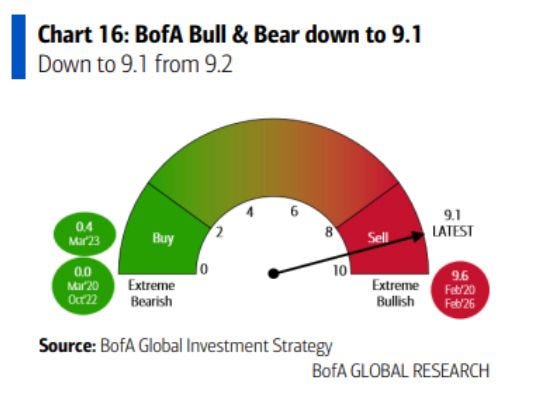
Bank of America’s Bull and Bear Indicator ticked down to 9.1 from 9.2 and remains deep in what the bank labels a contrarian sell signal. The scale runs from 0, extreme bearish, to 10, extreme bullish. Anything above 8 marks positioning crowded enough to flag elevated risk. At 9.1, sentiment sits near the ceiling.
The reflex is to read that as an instruction. It is not one, and the difference is the entire lesson.
Consider what actually moved the gauge. The indicator blends fund flows, market breadth, and credit technicals. This latest dip came from equity fund outflows and softening credit, with high yield and AT1 bank bond spreads widening. Spreads deserve the attention here, because credit usually cracks before equities do. When bond investors quietly demand more yield to hold risk, they are repricing it ahead of the louder move in stocks.
Then consider the track record, which forces some humility in both directions. Since 2002, this sell signal has fired 17 times. The average outcome: global equities down roughly 2 to 3 percent over the following two to three months. The bad episodes: drawdowns of 15 to 20 percent. The signal is right more often than not, the typical damage is modest, and occasionally it precedes something much worse. That gap between the mild average and the deep tail is the real risk being flagged.
So what is a defensible response? Not going to cash on one number. The asymmetry argues for tightening rather than exiting: smaller new positions, closer stops, more patience on entries. Reduce how much a drawdown can take from you instead of trying to guess its start date.
It helps to separate three ideas that get blurred whenever a sentiment extreme makes headlines. Probability is not prediction: a 9.1 raises the odds of a pullback without setting its date or depth. Risk management is not a market call: the productive move shrinks potential losses rather than forecasting the high. And regime is not entry: the signal describes the environment, not which stock to sell.
Treated that way, an extreme sentiment reading becomes an input rather than a verdict. When the backdrop turns cautious, the work shifts toward selectivity: leaning on genuinely strong industries for long exposure, staying more open to shorts in weak ones, and letting the market reveal whether this signal belongs with the mild thirteen or the ugly four.
A 9.1 is not a countdown. It is a measured statement that positioning is crowded and pullback odds have risen. Traders who hear a prediction get whipsawed. Traders who hear a risk input adjust exposure and keep their downside defined.
Full research and methodology at imgeld.com